
Welcome to the IfR and its Internet presentation!

The IfR serves as a nation-wide professional organisation representing more than 1.700 planners. It is eager to use the Internet as an opportunity to present up-to-date news and information for its membership and others interested in spatial planning. At the click of the mouse the services of the IfR will be at your disposal including a calendar of events as well as a forum for discussion. The IfR thus becomes an information exchange providing news, facts and contacts related to spatial planning.
About the IfR
The 'Informationskreis für Raumplanung e.V.' was established in 1975 at the University of Dortmund, Germany. Today, it represents about 1.700 planners of various fields. Its members work for public planning agencies on all levels of government and administration, for private planning consultants, housing corporations, planning branches of private businesses, chambers of commerce, associations, political parties, at universities in the areas of teaching as well as research and in other research institutions. All members share a common interest in the wide range of planning topics and their discussion.
The IfR serves as an information exchange ready to supply planning-related news, facts and contacts in a timely and uncomplicated way. The IfR therefore plays an important role in disseminating news and trends in the areas of spatial planning practice as well as theory.
Differing interests and opinions may use the IfR as a platform for presentation, discussion, and the development of new ideas. This may also be appreciated as resource for the day-to-day business of working in the field of planning. The importance that the IfR places on facilitating networking and communication between different interests, subjects, administrative levels of planning, students and practitioners reflect the interdisciplinary and complex nature of spatial planning.
IfR-Objectives
IfR's primary purpose is to advance the science and practice of planning as an interdisciplinary activity at the local, regional, state, national and international levels. To this end, the IfR pursues the following goals:
- to review and discuss current trends in the field of spatial planning (within its various chapters and special interest groups),
- to report on planning experience and research (e.g., through its journal ' RaumPlanung'),
- to offer opportunities for the exchange of knowledge in the fields of planning theory and practice, (and training),
- to facilitate the communication between students and practitioners of spatial planning (e.g., at conferences),
- to assist in the development of training and education curricula,
- to serve as a lobbying organisation for furthering the interests of spatial planning,
- to establish and maintain contacts with other, related organisations.
IfR-Activities
Conferences, Seminars etc.
The IfR sponsors one annual conference that focuses on a current spatial planning issue. Such issues in the recent past have been the conversion of premises formerly used for military purposes, the prospects for large prefabricated housing districts especially in Eastern Germany, regional management, etc. Apart from the annual conference the IfR frequently co-sponsors conferences and seminars with other organisations. In co-operation with foreign planning associations, the IfR has in the past also offered study trips and excursions to its membership.
Sections and Regional Chapters
The IfR's many sections and regional chapters represent a major element in the working of the associations as a whole. With various degrees of intensity, these groups engage in a variety of activities all aimed at furthering the exchange of planning-related information and experiences either related to certain issues or specific locations. Taken as a whole, the sections cover not only a more traditional range of planning fields such as urban and regional planning, transport planning, etc. but also issues that cut across those fields such as co-operative planning approaches, computer technology and planning, women and planning etc. The regional chapters reflect the spatial distribution of planning students and practitioners and cover most of the metropolitan areas in Germany.
Student Competition
About every other year the IfR organises an interdisciplinary student competition. With these competitions the IfR tries to confront students with challenging planning topics and to stimulate them to develop innovative approaches and solutions. Great emphasis is placed on a holistic approach to planning problems. In the past, competitions have focused on the redevelopment of a large prefabricated housing project in the Saxonian city of Hoyerswerda, and the sustainable development in the Brandenburg city of Brandenburg an der Havel.
Journal
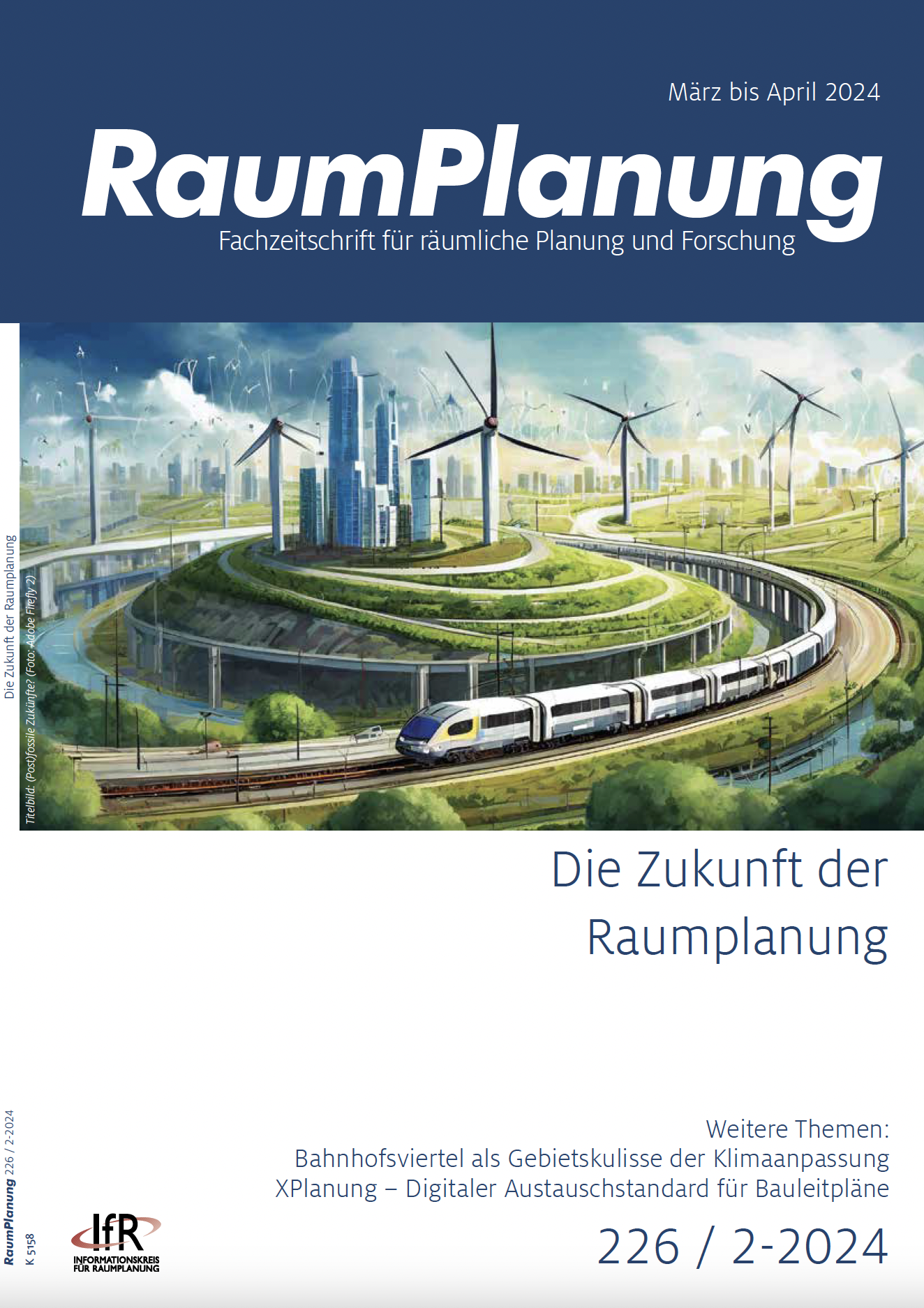
The IfR publishes the journal 'RaumPlanung' which has become one of the highly regarded German language journals in the field of planning. Issued every three months each issue of the 'RaumPlanung' either covers a variety of planning subjects or focuses on a comprehensive discussion of one specific topic. In either case, The 'RaumPlanung' always tries to provide a forum for both the presentation of major developments in planning theory as well as practice. In addition to its articles the journal also includes a planning news section, book reviews and programme guides.
Lobbying
The IfR is steadily increasing its lobbying efforts as a representation of the planning profession. This does not only include its involvement in the legislative process but also refers to various initiatives to further the recognition of spatial planners as equal members among other organisations that may have a much longer history. Furthermore, the IfR is also active in the fields of planning education and training reviewing and commenting on respective curricula and reform initiatives.
Membership
According to the IfR's bylaws everybody interested in spatial planning may qualify as an individual member. This also includes students of the different planning schools in Germany and beyond.
Membership dues are 120 Euro per year. Students and members with a low income can apply for a reduced rate of 60 Euro. Membership dues are to be paid at the beginning of the calendar year. Since the IfR meets the requirements established by law for a scientific organisation, the membership dues are tax-exempt.
The journal RaumPlanung is free to all IfR members. In addition to this journal each member regularly receives a copy of the newsletter 'IfR-Mitteilungen' and in greater intervals updates of the membership directory. Further benefits of IfR membership are the reduced conference and seminar rates for IfR activities as well as those sponsored by other organisations such as the SRL.
Subscription
Non-members may also subscribe to the IfR journal RaumPlanung at a cost of 91 Euro per volume (including shipping and handling), or 19 Euro per issue (plus shipping and handling).
IfR-Office
The IfR office is located in Dortmund, Germany. Its address is as follows:
Informationskreis für Raumplanung e.V.
Gutenbergstraße 34
D-44139 Dortmund
Germany
Phone: +49 231 759570
Fax: +49 231 759597
E-Mail: info(at)ifr-ev.de
The staff of the IfR Dortmund office is happy to serve your requests during its opening hours, i.e., Mondays, Wednesdays, and Fridays, 9:00 to 14:00 h.
The IfR keeps accounts with the Postbank Dortmund (Bank-Identification-No.: 440 100 46), Account-No.: 0206336465, and the Stadtsparkasse Dortmund (Bank-Identification-No: 440 501 99), Account-No.: 001 103 296.


English Summary


Die IfR-Gruppe